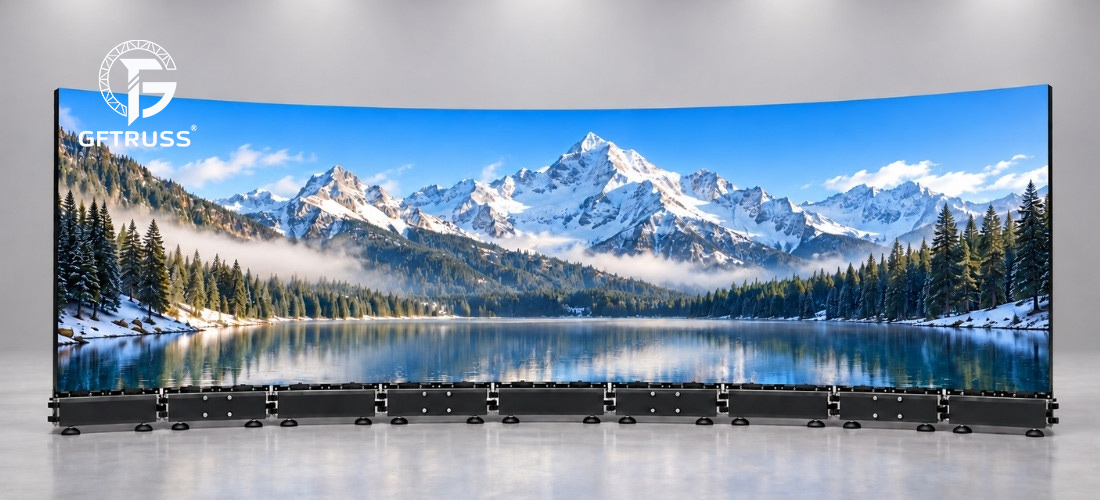
Straight and curved LED walls may use the same LED cabinet dimensions and occupy a similar overall area, but their support structures are not designed in the same way. The LED cabinet arrangement determines the structure’s connection method and installation requirements.
A straight LED wall is built on a straight line, so its support system is relatively simple and uniform. A curved LED wall, however, requires the LED cabinets to be positioned at specific angles. The supporting structure must therefore accommodate changes in direction while maintaining accurate alignment, and stability.
This article explains how curved LED wall supports differ from straight LED wall support systems, including changes to the ground beams, bases, cabinet locks and supporting components. It also covers the cabinet angles and project information required to plan a curved LED support system.
Straight vs Curved LED Wall Supports at a Glance
| Comparison Point | Straight LED Wall Support | Curved LED Wall Support |
| Available layouts | Straight layouts only | Can be configured as a straight or curved layout |
| Ground beam connection | Adjacent ground beams are secured with integrated locks | Adjacent ground beams use pin connections without locks between the ground beams |
| Base design | Normally uses a larger base | Uses a long, narrow telescopic base |
| Base adjustment | Cannot be extended | Can be extended or retracted |
| Quick lock | Can be used to secure compatible LED cabinets | Can also be used to secure compatible LED cabinets |
| Additional cabinet lock | Can use a screw lock | Uses a hinge lock instead of a screw lock |
| Diagonal bracing | No diagonal bracing | Connects the base to the ladder truss to improve stability |
| Crossbar | Uses a fixed-length crossbar | Uses a telescopic crossbar |
| Pedal | Uses a fixed-length pedal | Uses an extendable pedal |
* The main differences are found in the ground beams, bases, locking components and rear support arrangement. These changes allow the curved system to follow different cabinet angles instead of remaining in one fixed line.
How Are the Two LED Wall Support Systems Organized?
Both straight and curved LED wall ground supports are built around the same general component categories. These normally include ground beams, bases, ladder trusses, cabinet locks, crossbars and pedals.
These shared component names provide a useful reference for comparison, but the individual parts are not necessarily identical or interchangeable. Their dimensions, connection methods and adjustment features depend on whether the LED wall is arranged in a straight or curved layout.
For a broader introduction to the components, types and applications, read our guide to LED wall ground support systems.
What Defines the Shape of a Curved LED Wall?
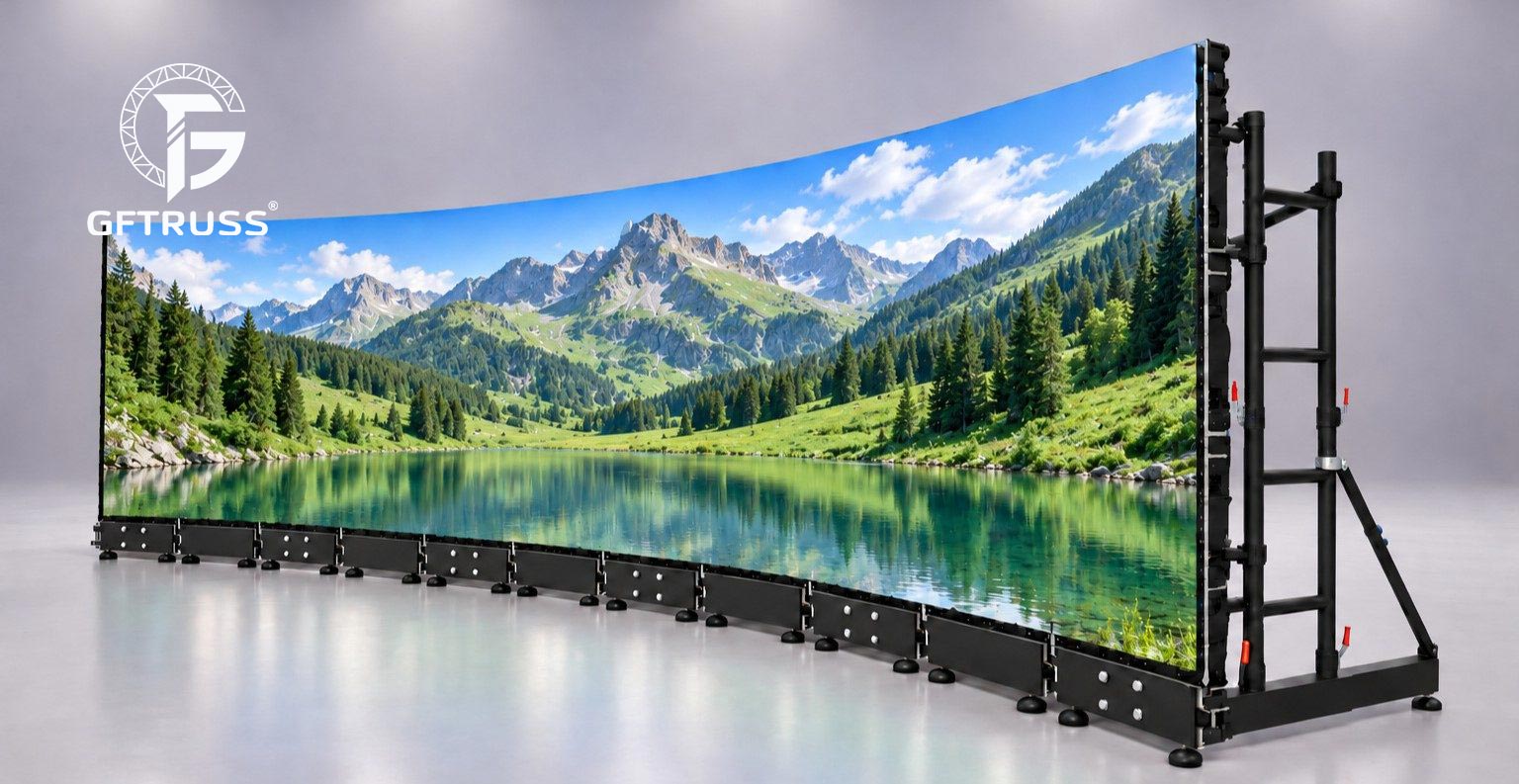
A curved LED wall cannot be defined by its width and height alone. Its final shape also depends on the overall curvature, and whether it forms an inner or outer curve.
l Angle of LED Cabinets
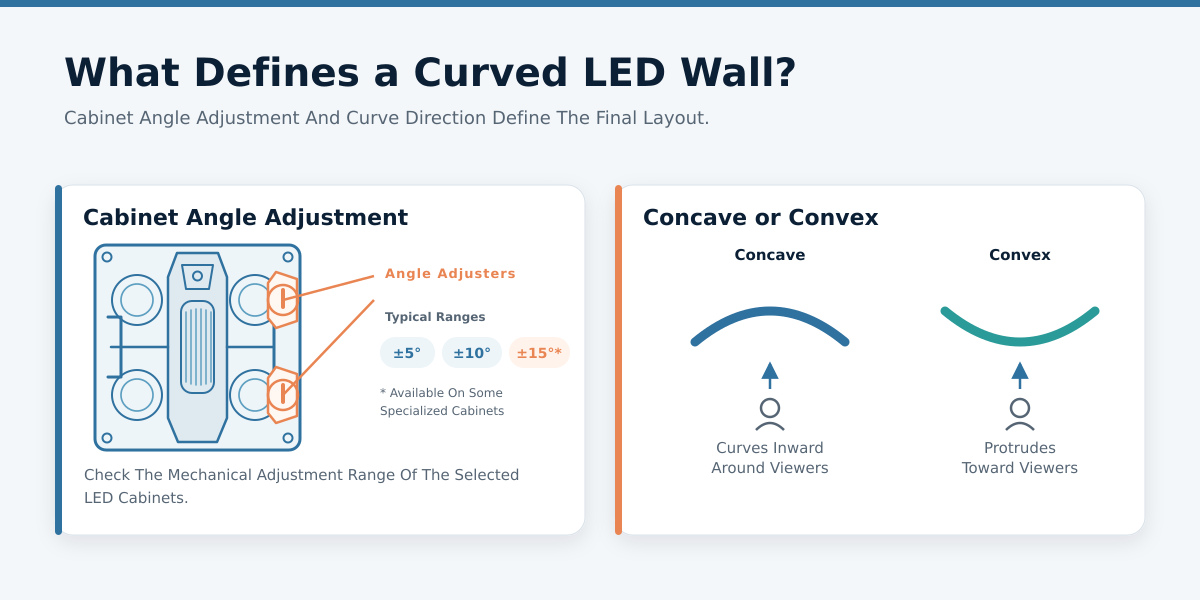
Many curved LED walls are assembled from LED cabinets positioned at controlled angles. Each LED cabinet faces in a slightly different direction, creating the complete curved display.
The available angle depends on the cabinet design and the selected locking method. Some LED cabinets have compatible quick lock holes that allow several angle settings. Other cabinets require hinge locks to create the required angle.
l Quick Locks vs Hinge Locks for Curved LED Walls
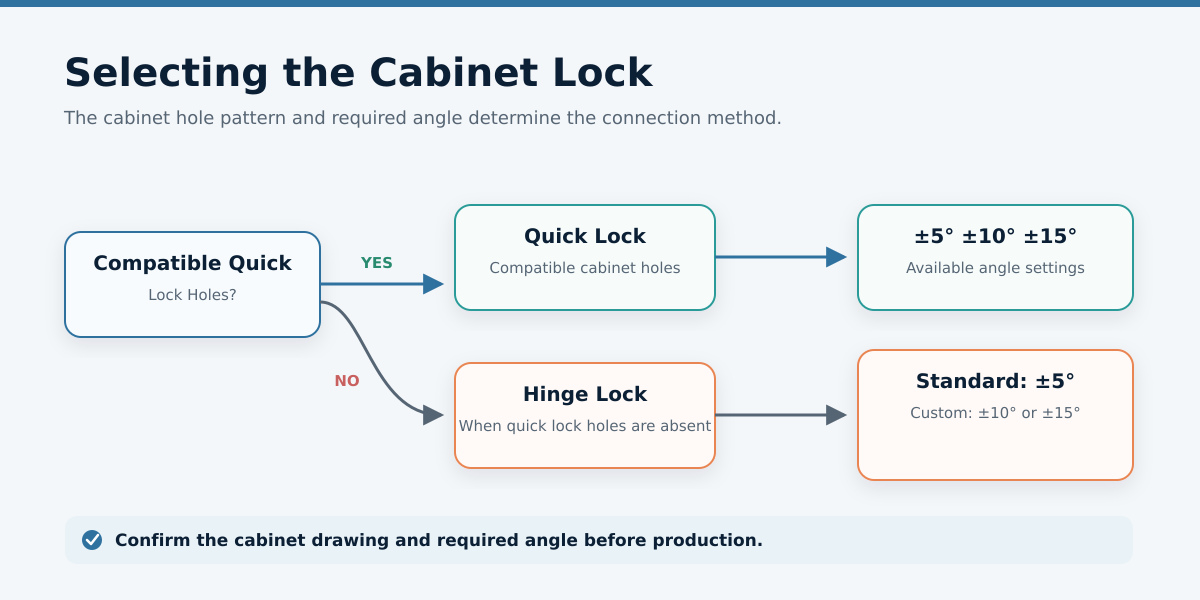
When the LED cabinet has compatible quick lock holes, the support system can be configured for LED cabinet angles of ±5°, ±10° or ±15°.
When the cabinet does not have quick lock holes, hinge locks are required. A standard hinge lock can accommodate ±5°. Projects requiring ±10° or ±15° need customized connection accessories.
The required angle and the availability of quick lock holes should be confirmed before production. For cabinets without quick lock holes or projects requiring customized angles, GF-Truss can review the cabinet drawing and help identify suitable connection accessories.
l Concave or Convex Layout
The viewing direction must also be identified. A concave screen curves inward around the viewing area. A convex screen curves outward. Although both layouts use curved cabinet arrangements, the direction of the ground beams and supporting components will be different.
A project drawing should clearly mark the viewing side to prevent the support structure from being configured in the opposite direction.
l Adjustment of Supporting Components
The curved support system uses telescopic bases, crossbars and diagonal bracing. These components can be extended or retracted to match the required structural arrangement.
The shape of the screen is therefore not created by adjusting one component alone. The LED cabinets, ground beams, bases, crossbars, ladder trusses and diagonal braces must be configured as a complete system.
What Changes in a Curved LED Wall Support?
The most important changes involve the ground beams, bases, cabinet locks and supporting components behind the LED wall. For a practical overview of how these components are assembled,you can read our guide on how to install LED wall ground supports.
l Ground Beam Connection Method
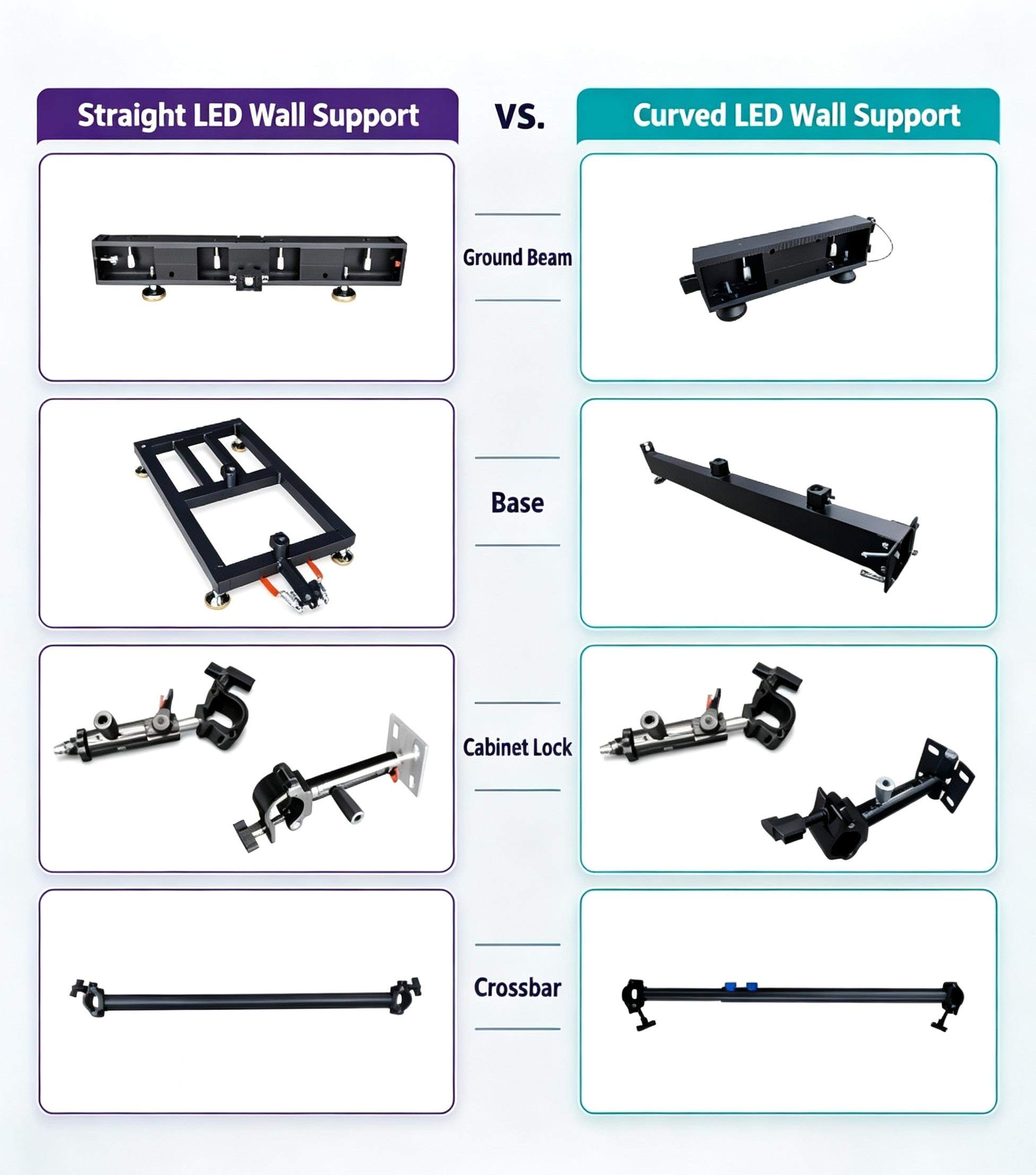
The ground beam is one of the main differences between straight and curved LED wall supports. On a straight LED wall ground support, adjacent ground beams are secured using locks installed on the beams. These locks keep the sections in one continuous straight line and prevent their direction from changing.
However, the curved support does not use locks between adjacent ground beam sections. Instead, the sections are connected using pins. This allows each ground beam section to follow the required direction of the curved cabinet layout.
If the curved ground beams were rigidly locked together in the same way as the straight ground beams, the structure could not form the required curve. The pin connection allows the direction to change, but the ground beam sections must still be correctly connected and secured according to the product design.
l Base Size and Shape
Straight LED wall supports normally use larger bases because the cabinets do not need to be positioned at different angles. The larger base provides a wider and more stable foundation for the fixed straight arrangement.
The curved support uses a long and narrow base. Its telescopic design allows the working length to be adjusted according to different requirements. This adjustment helps the base coordinate with different curved layouts. It also allows the curved support system to be arranged in a straight line when required.
l LED Cabinet Locking Method
Both straight and curved LED wall supports can use quick locks to secure compatible LED cabinets.
A straight LED wall support can also use a screw lock because the cabinets remain on one fixed plane. A curved LED wall support cannot use the same screw lock arrangement. The direction of the cabinets changes across the display, so the locking component must accommodate the changing cabinet angles.
When the LED cabinet does not have compatible quick lock holes, a hinge lock is used for the curved LED wall configuration. Its hinged structure allows the locking component to follow the cabinet direction while maintaining the required connection to the support.
The locking method should be confirmed from the LED cabinet drawing. Cabinet dimensions alone are not sufficient because mounting holes and locking positions may vary between manufacturers.
l Diagonal Bracing and Telescopic Components
Straight LED wall supports do not use diagonal bracing. Their crossbars and platforms have fixed lengths.
In contrast, the curved LED wall support uses diagonal braces to connect the telescopic bases to the ladder trusses. These braces help the lower and rear components work together as a stable support arrangement. The crossbars and pedals are also telescopic. Their lengths can be adjusted to match the selected straight or curved layout.
Information Needed to Design a Curved LED Wall Support
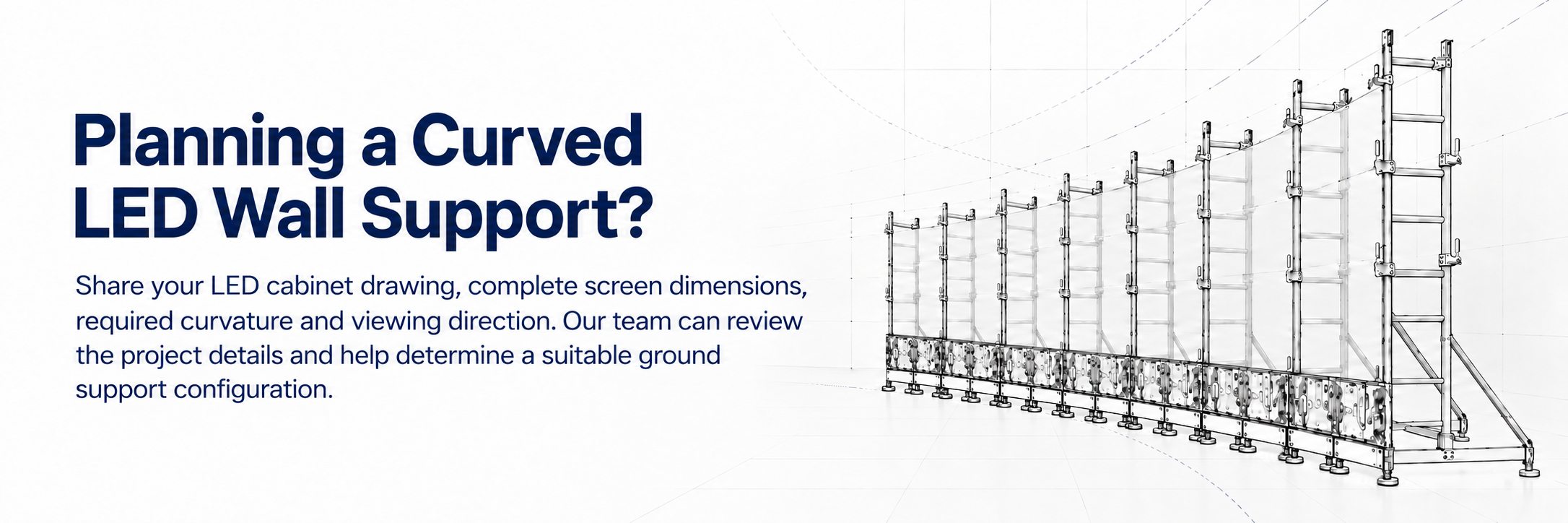
Complete cabinet and layout information allows the supplier to select the correct ground beams, locks and adjustable components.
l LED Cabinet Specifications
Provide the technical drawing of a single LED cabinet. The drawing should show:
1. Cabinet width and height
2. Lock hole positions
3. Availability of quick lock holes
l Screen and Curve Information
Provide the overall width and height of the complete LED wall. The project should also identify:
1. Whether the required angle is ±5°, ±10° or ±15°
2. Whether the wall is concave or convex
 |
 |
Common Curved LED Wall Support Planning Mistakes
l Using Straight Ground Beams to Create a Curve
Straight ground beam locks hold adjacent beam sections in one line. They cannot provide the angle changes required by a curved screen. Using straight ground beams for a curved LED wall may result in an unnatural curve, and the adjacent cabinets are highly likely to be unable to lock together correctly.
l Selecting Locks Without Checking the LED Cabinet
LED cabinets with compatible quick lock holes can use ±5°, ±10° or ±15° settings. Cabinets without these holes require hinge locks. Standard hinge locks support ±5°, while ±10° and ±15° require customized accessories.
l Omitting Rear Installation Space
Curved LED wall supports require space for the telescopic bases, ladder trusses and diagonal braces. The visible screen dimensions do not represent the complete LED wall support footprint.
l Providing Only the Screen Wall Dimensions
Width and height do not define the curve. Customers requesting a custom curved LED wall support are expected to provide the dimensions and drawing of a single LED cabinet, the overall dimensions of the complete LED wall, whether the wall should form a concave or convex curve, and the required curvature.
Conclusion
Straight LED wall supports use locked ground beams and fixed supporting components to maintain one line. Curved LED wall supports use pin connected ground beams, telescopic bases, adjustable crossbars, telescopic platforms and diagonal bracing to accommodate different layouts.
A curved support can be arranged as either a straight or curved structure, while a dedicated straight support can only support a straight LED screen wall. Accurate LED cabinet drawings, locking information and layout dimensions should be confirmed before production.
Explore GF-Truss straight and curved LED wall support solutions for different cabinet layouts and project requirements.
FAQ
What Is the Main Difference Between Straight and Curved LED Wall Supports?
Straight ground beams use integrated locks to maintain one fixed line. Curved ground beams use pin connections so each ground beams can change direction flexibly. Straight LED wall ground supports use fixed bases, crossbars and pedals, while curved supports use telescopic components and diagonal bracing.
Can a Curved LED Wall Support Be Used for a Straight LED Screen wall?
Yes. The ground beam sections can be aligned in one direction for a straight LED screen or positioned at different angles for a curved screen. A dedicated straight LED wall support cannot be adjusted into a curved configuration.
What Angles Can a Curved LED Wall Support Create?
LED cabinets with compatible quick lock holes can be arranged at ±5°, ±10° or ±15°. Cabinets without quick lock holes require hinge locks. A standard hinge lock provides ±5°. Customized accessories are required for ±10° or ±15°.
Why Are Curved Ground Beams Connected with Pins?
Pin connections secure adjacent ground beam sections while allowing their direction to change. If the sections were locked together like straight ground beams, they would remain in one line and could not follow the curved LED cabinet layout.
What Information Is Needed to Quote a Curved LED Wall Support?
Please provide the dimensions and drawing of a single cabinet, the overall dimensions of the complete LED wall, whether the wall should form a concave or convex curve, and the required curvature.


 IPv6 network supported
Leave A Message
Scan to Whatsapp :

Hi! Click one of our members below to chat on
 Tel :
Tel : Email :
 English
 Français
 Pусский
 Español
 العربية